Changins
Viticultural analytical chemistry and microbial ecology, under Prof. Markus Rienth.
An Innosuisse innovation project
Viticultural analytical chemistry and microbial ecology, under Prof. Markus Rienth.
Probabilistic modeling and active-inference agent development.
Technology development, pilot operation, and field work.
To further develop and validate the system, Swiss Soil will conduct a two-season research pilot in Vaud, funded by Innosuisse. The Field State Model will be developed and run on real field data. The pilot will generate the agronomic evidence base required to deploy the AUM service at scale.
No commercial or academic actor worldwide currently combines extensive plant sap metabolomics, adaptive robotic microscopy, a multi-modal generative model of soil and plant as one field, and active-inference agents into one operating system.
Research objectives, not results already achieved.
Establish the metabolite-disease correlation panel linking sap signatures to mildew, botrytis, and other disease and define which of these signatures correlates to grape quality at harvest.
Identify which morphological features observed through live microscopy carry diagnostic information about soil microorganism identity and health, and function to abstract those features into the Field State Model.
Fine-tune the Field State Model on real multi-modal field data from the two-season pilot.
Build active-inference agent architecture (Input, Sampling, Actuation) operating with feedback from the Field State Model.
Detect the biological signatures of microorganisms which were inoculated to determine that they actually survived and proliferated in the field environment.
The Field State Model will be developed and run on real field data. The platform’s three core agents will be built and functioning to direct management decisions on a working vineyard.
Vineyard profiling and baseline sampling will begin after the harvest in Q4 2026, alongside controlled pre-season testing with Changins. These observations will establish the soil baseline and feed into the models before the 2027 growing season.
In 2027, field operations will cover one hectare under active management, with three control hectares for comparison. In 2028, operations will expand to six hectares under active management and three control hectares. This second season will test the repeatability of the first season’s findings and provide further evidence of yield, quality and soil-health outcomes.
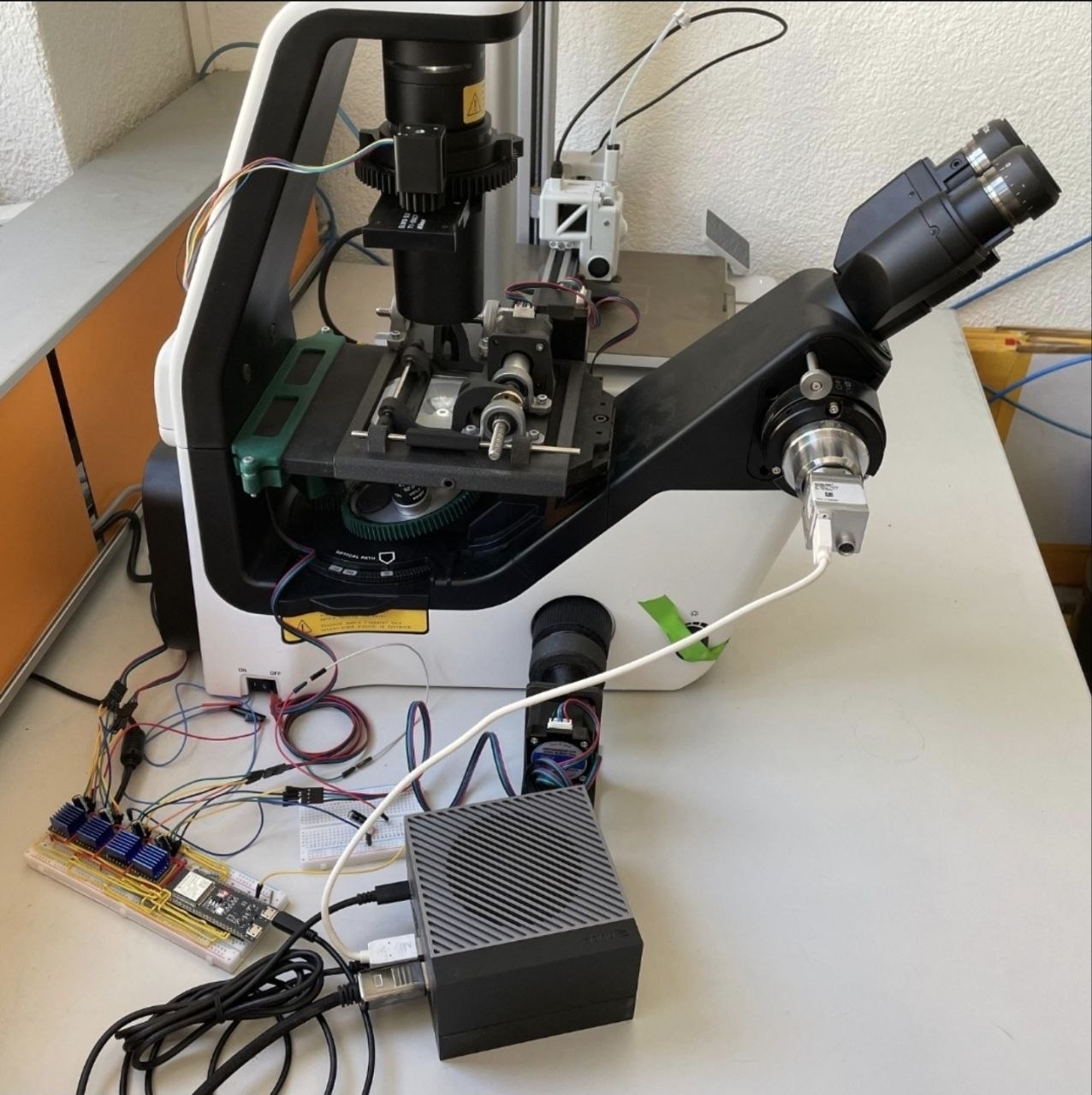 Nikon Eclipse TS2 · embedded NVIDIA Jetson
The robotic, agent-controlled microscopy component uses an adaptive control loop that decides what to focus on, where to image, and when to stop.
A curated soil microorganism image library, cross-validated against DNA sequencing and enzymatic ground truths, will support the Field State Model.
The corrective biological mechanism is biologically complete inoculum produced through a Johnson-Su aerobic composting process.
Each Johnson-su bioreactor is inoculated with indigenous microorganisms collected from local Swiss biomes, including forest soils, alpine meadows, and undisturbed field margins, and matures for twelve to twenty four months without disturbance.
This allows natural microbial succession, fungal establishment, and the formation of complex microbial consortia adapted to one another before application.
The compost is extracted into a liquid and applied directly to the soil surface, delivering intact microbial communities primed for the local environment rather than isolated strains.
Project 135.358 IP-EE · January 2027 – December 2028. The service and platform are being developed and validated through the project.